
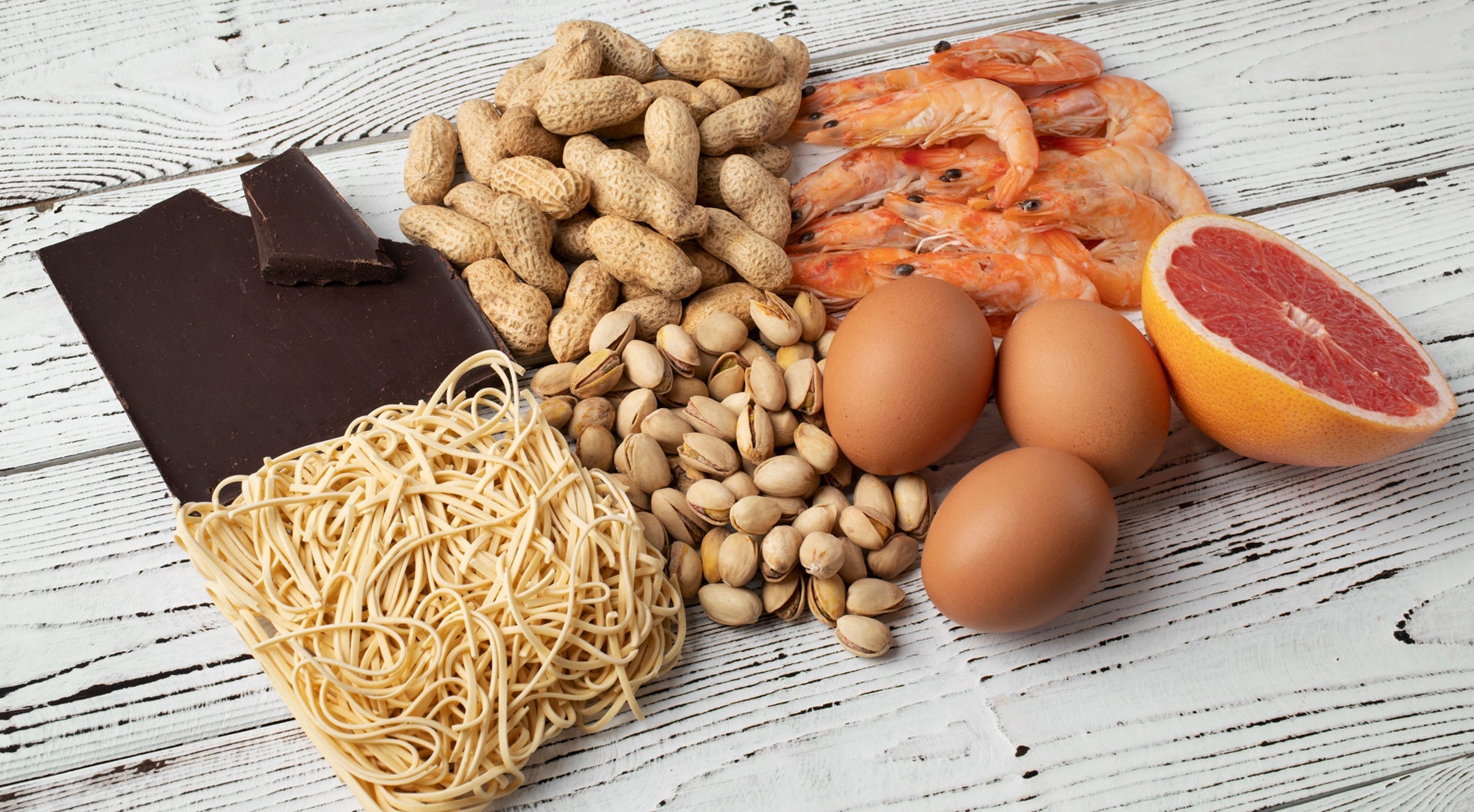
Food Sensitivity vs Food Allergy: Why You're Really Bloated
Key Takeaways
- A food allergy triggers your immune system and can be life-threatening. A food sensitivity is a digestive issue, usually caused by missing or low enzymes, and produces symptoms like bloating, gas, and discomfort.*
- Nearly 19% of U.S. adults believe they have a food allergy, but only about 10.8% actually do. The rest are likely dealing with a food sensitivity or intolerance they have not identified yet.
- Roughly 18% of people worldwide experience bloating at least once a week, and women are about twice as likely to report it as men.
- Enzyme production naturally declines with age. Lipase and chymotrypsin output begins decreasing after age 30.
- Digestive enzyme supplementation may help support comfortable digestion by assisting in the breakdown of proteins, fats, and carbohydrates.*
- Talk to your healthcare provider before starting any new supplement.
What Is the Difference Between a Food Allergy and a Food Sensitivity?
A food allergy is an immune system reaction. Your body releases IgE antibodies that activate mast cells and basophils, flooding your system with histamine. That response can happen within minutes and, in serious cases, can lead to anaphylaxis.
A food sensitivity (also called a food intolerance) is different. It starts and stays in the digestive system. The body simply lacks enough of the right enzymes to properly break down a specific food component. Undigested material sits in the gut, ferments, and produces gas, bloating, and discomfort.
The most common example is lactose intolerance. Without enough lactase, undigested lactose reaches the colon, where bacteria ferment it into hydrogen, carbon dioxide, and methane.
Here is a quick comparison:
Food Allergy |
Food Sensitivity / Intolerance |
|
|---|---|---|
System involved |
Immune system (IgE-mediated) |
Digestive system (enzyme deficiency) |
Reaction time |
Minutes to 2 hours |
Hours to days |
Severity |
Can be life-threatening (anaphylaxis) |
Uncomfortable, not life-threatening |
Common symptoms |
Hives, swelling, difficulty breathing, vomiting |
Bloating, gas, cramping, diarrhea |
Cause |
Immune overreaction to a food protein |
Missing or insufficient digestive enzymes |
Amount matters? |
Even trace amounts can trigger a reaction |
Usually dose-dependent: more food, more symptoms |
Why Am I Bloated After Eating?
Bloating after meals is incredibly common. A 2023 study published in Gastroenterology surveying more than 51,000 people across 26 countries found that nearly 18% of the global population experiences bloating at least once a week. Among adults aged 18 to 34, the rate was over 20%.
When your body does not have enough enzymes to fully break down what you ate, partially digested food moves into the large intestine. Gut bacteria ferment that material and produce gas as a byproduct. That gas stretches the intestinal walls and creates the pressure and swelling most people recognize as bloating.
This is why bloating often strikes after specific foods rather than after everything you eat. Dairy, beans, cruciferous vegetables, wheat, and high-fat meals are among the most common triggers because each requires a specific enzyme (or set of enzymes) to digest properly.
Can You Develop a Food Sensitivity Later in Life?
Yes. You can eat a food for decades without issue, then one day start bloating every time you have it.
The reason often comes back to enzyme production. Research published in Aging Medicine found that digestive enzymes like lipase and chymotrypsin begin declining after age 30. A separate study of adults over 60 found that roughly one in five otherwise healthy older adults had pancreatic enzyme output below the clinical threshold for exocrine insufficiency.
Beyond aging, stress, gut inflammation, and dietary shifts can reduce enzyme activity. Even low-grade intestinal inflammation has been shown to suppress the expression of lactase, sucrase, and aminopeptidase.
If foods you used to tolerate are now causing problems, your enzyme capacity may have changed rather than you having developed an allergy.
How Do Digestive Enzymes Help With Food Sensitivity?
Your body naturally produces digestive enzymes to break food into usable molecules. Each enzyme targets a specific component: protease handles proteins, lipase handles fats, amylase handles starches, lactase handles dairy sugar, and alpha-galactosidase handles the complex sugars in beans and cruciferous vegetables.
When your body does not produce enough of a particular enzyme, supplementing with that enzyme may help support more comfortable digestion.* A randomized, double-blind, placebo-controlled trial found that participants taking a multi-enzyme supplement for two months showed significant improvements in digestive comfort and quality of life compared to placebo.
A 60-year review of clinical trials found consistent evidence that multi-enzyme supplementation supported reductions in bloating, abdominal distension, and post-meal fullness. And targeting a specific enzyme to a specific food substrate works too. A randomized controlled trial on alpha-galactosidase found significant reductions in days with moderate-to-severe bloating and flatulence.
Broad-spectrum enzyme blends covering multiple enzyme types tend to outperform single-enzyme supplements because any given meal may challenge more than one enzyme pathway.
Farmana's Digest + Debloat contains a full-spectrum enzyme blend (Protease, Bromelain, Papain, Amylase, Glucoamylase, Beta Glucanase, Lactase, Cellulase, Hemicellulase, and Lipase) alongside 900mg of organic papaya and whole food ingredients like ginger, fennel, and dandelion that have traditionally been used to support digestive comfort.*
Frequently Asked Questions
Can bloating be the only symptom of a food intolerance?
Yes. Bloating is one of the most common standalone signs that your body is struggling to break down a particular food. Some people also experience gas, cramping, or bowel changes, but many notice bloating as the only consistent symptom.
How long after eating do food sensitivity symptoms appear?
Anywhere from a few hours to a full day or two after eating the trigger food. This delayed response is one of the main reasons food sensitivities are harder to identify than food allergies, which tend to produce symptoms within minutes.
Should I take digestive enzymes with every meal?
It depends on your needs. Some people use enzyme support only with foods that give them trouble (dairy, beans, high-fat meals). Others find daily use with meals helps support consistent digestive comfort.* Talk to your healthcare provider about what makes sense for you.
Are at-home food sensitivity tests accurate?
Most at-home tests measure IgG antibodies. Medical organizations including the American Academy of Allergy, Asthma & Immunology have raised concerns about the reliability of IgG-based testing for food sensitivities. An elimination diet guided by a healthcare provider remains the gold standard for identifying triggers.
What is the difference between a food sensitivity and IBS?
Food sensitivity refers to difficulty digesting a specific food, usually due to enzyme deficiency. IBS is a functional gastrointestinal condition with a broader set of triggers, including stress, gut motility issues, and nervous system factors. They are not the same condition, though food sensitivities can make IBS symptoms worse. Consult your healthcare provider for a proper evaluation.
These statements have not been evaluated by the Food and Drug Administration. This product is not intended to diagnose, treat, cure, or prevent any disease.

Author: Ashley Lizotte, MS
Ashley is a co-founder of Farmana with her Masters in Nutrition. She has spent 20 years in the health and wellness industry, working closely with functional medicine practitioners to formulate therapeutic dietary supplements and develop treatment protocols. Outside of her work - where she's deeply immersed in the latest scientific research in health and nutrition - Ashley channels her passion into local farmer's markets, perfecting her sourdough, prioritizing daily workouts, tending her garden, trying new recipes, and taking long walks with her Wirehaired Vizsla, Birdie.
References
-
Gupta RS, Warren CM, Smith BM, et al. Prevalence and Severity of Food Allergies Among US Adults. JAMA Netw Open. 2019;2(1):e185630. doi:10.1001/jamanetworkopen.2018.5630. PMID:30646188. https://pmc.ncbi.nlm.nih.gov/articles/PMC6324316/
-
Hage G, Sacre Y, Haddad J, et al. Food Hypersensitivity: Distinguishing Allergy from Intolerance, Main Characteristics, and Symptoms—A Narrative Review. Nutrients. 2025;17(8):1359. doi:10.3390/nu17081359. PMID:40284223. https://pubmed.ncbi.nlm.nih.gov/40284223/
-
Yu W, Hussey Freeland DM, Nadeau KC. Food allergy: immune mechanisms, diagnosis and immunotherapy. Nat Rev Immunol. 2016;16(12):751–765. doi:10.1038/nri.2016.111. PMID:27795547. https://pmc.ncbi.nlm.nih.gov/articles/PMC5123910/
-
Misselwitz B, Butter M, Verbeke K, Fox MR. Update on lactose malabsorption and intolerance: pathogenesis, diagnosis and clinical management. Gut. 2019;68(11):2080–2091. doi:10.1136/gutjnl-2019-318404. PMID:31427404. https://pmc.ncbi.nlm.nih.gov/articles/PMC6839734/
-
Angima G, Qu Y, Park SH, Dallas DC. Prebiotic Strategies to Manage Lactose Intolerance Symptoms. Nutrients. 2024;16(7):1002. doi:10.3390/nu16071002. PMID:38613035. https://pmc.ncbi.nlm.nih.gov/articles/PMC11013211/
-
Herzig KH, Purhonen AK, Räsänen KM, et al. Fecal pancreatic elastase-1 levels in older individuals without known gastrointestinal diseases or diabetes mellitus. BMC Geriatr. 2011;11:4. doi:10.1186/1471-2318-11-4. PMID:21266058. https://pmc.ncbi.nlm.nih.gov/articles/PMC3039595/
-
Wang L, Zheng S. Pancreatic senescence and its clinical manifestations. Aging Med (Milton). 2020;3(1):48–52. doi:10.1002/agm2.12095. PMID:32232192. https://pmc.ncbi.nlm.nih.gov/articles/PMC7099748/
-
Ullah H, Di Minno A, Piccinocchi R, et al. Efficacy of digestive enzyme supplementation in functional dyspepsia: A monocentric, randomized, double-blind, placebo-controlled, clinical trial. Biomed Pharmacother. 2023;169:115858. doi:10.1016/j.biopha.2023.115858. PMID:37976892. https://pubmed.ncbi.nlm.nih.gov/37976892/
-
Graham DY, Ketwaroo GA, Money ME, Opekun AR. Enzyme therapy for functional bowel disease-like post-prandial distress. J Dig Dis. 2018;19(11):650–656. doi:10.1111/1751-2980.12655. PMID:30101562. https://pmc.ncbi.nlm.nih.gov/articles/PMC6910206/
-
Di Nardo G, Oliva S, Ferrari F, et al. Efficacy and tolerability of α-galactosidase in treating gas-related symptoms in children: a randomized, double-blind, placebo controlled trial. BMC Gastroenterol. 2013;13:142. doi:10.1186/1471-230X-13-142. PMID:24063420. https://pmc.ncbi.nlm.nih.gov/articles/PMC3849317/
-
Ballou S, Singh P, Nee J, et al. Prevalence and Associated Factors of Bloating: Results from the Rome Foundation Global Epidemiology Study. Gastroenterology. 2023;165(3):647–655.e4. doi:10.1053/j.gastro.2023.05.049. PMID:37315866. https://pmc.ncbi.nlm.nih.gov/articles/PMC10527500/
-
Riccio P, Rossano R. Undigested Food and Gut Microbiota May Cooperate in the Pathogenesis of Neuroinflammatory Diseases: A Matter of Barriers and a Proposal on the Origin of Organ Specificity. Nutrients. 2019;11(11):2714. doi:10.3390/nu11112714. PMID:31717475. https://pmc.ncbi.nlm.nih.gov/articles/PMC6893834/
- Peuhkuri K, Vapaatalo H, Korpela R. Even low-grade inflammation impacts on small intestinal function. World J Gastroenterol. 2010;16(9):1057–1062. doi:10.3748/wjg.v16.i9.1057. PMID:20205274. https://pmc.ncbi.nlm.nih.gov/articles/PMC2835780/


Leave a comment
This site is protected by hCaptcha and the hCaptcha Privacy Policy and Terms of Service apply.